
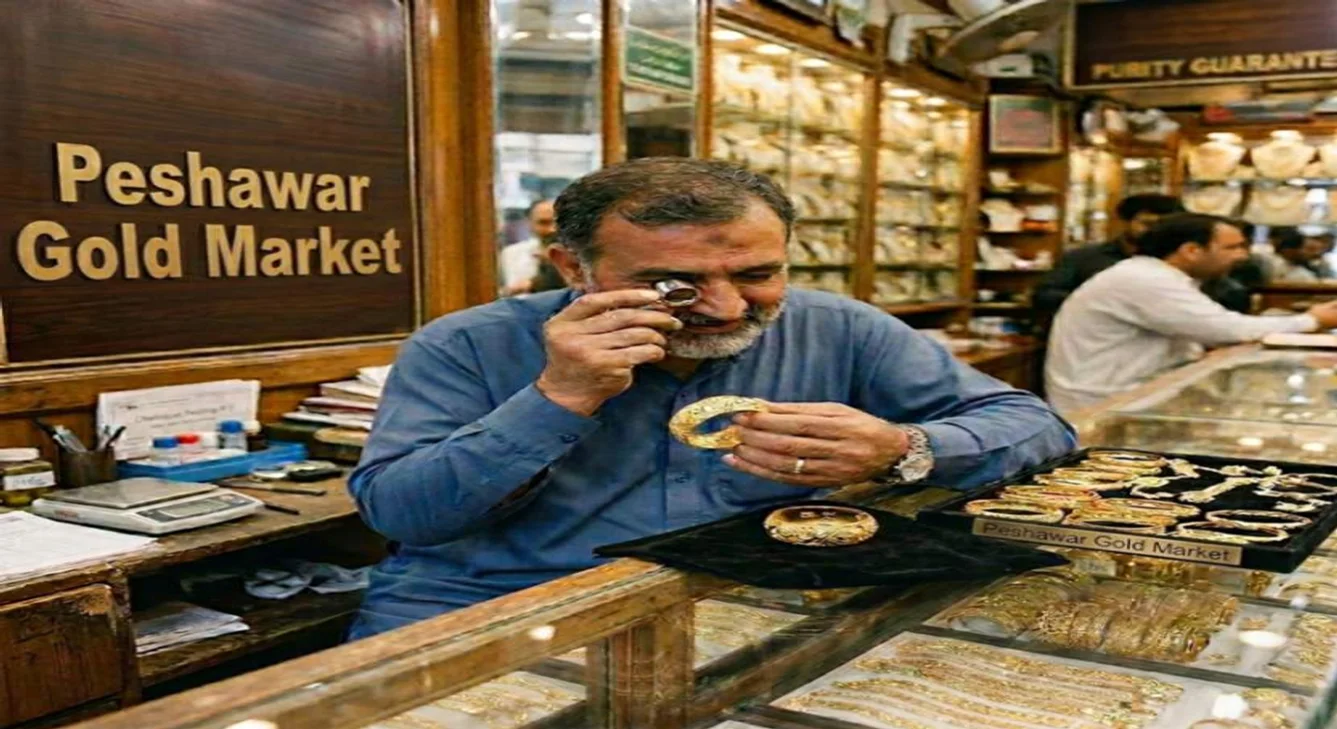
Verifying gold purity in Pakistan requires 3 sequential methods: reading the hallmark stamp, requesting a touchstone acid test, and using XRF electronic testing for high-value purchases. This guide explains every verification method available to Pakistani buyers, what each method confirms, where each method fails, and how to apply this knowledge before paying for any gold piece, whether in a Sarafa Bazaar, a branded showroom, or online.
Why Pakistani Gold Buyers Need to Verify Purity Themselves
Gold misrepresentation in Pakistani markets causes buyers to pay 22K prices for 18K or 20K gold, a financial loss of 8% to 17% of the total gold value on every affected transaction.
The financial stakes become concrete with specific numbers. A buyer purchasing a 3-tola bridal bangle set at 22K prices pays approximately PKR 1,050,000 for the gold component alone at current market rates. If the actual karat is 20K containing 83.3% pure gold rather than 91.6%, the buyer receives gold worth approximately PKR 955,000. The difference of PKR 95,000 disappears silently, with no visible evidence on the finished piece.
Gold misrepresentation occurs in Pakistani markets through 3 documented mechanisms:
- Alloy substitution during manufacturing: Goldsmith increases the base metal ratio while maintaining the visual appearance through surface treatment
- Hallmark fraud: Stamps indicating higher karat applied to lower purity pieces in unregulated production environments
- Verbal misrepresentation: Seller states karat verbally without providing documentation, the most common and least detectable form
Misrepresentation does not occur exclusively among unregistered street sellers. Established shops with long customer histories have produced mis-stamped pieces due to supply chain failures or craftsman substitution. Trust in a seller reduces but does not eliminate purity risk.
3 buyer categories bear the highest financial exposure from unverified gold:
- Wedding and Barat buyers are purchasing full bridal sets worth PKR 1,500,000 to PKR 6,000,000.
- Jahez buyers assembling collections intended to hold value across generations
- Savings-linked buyers are treating gold as a financial asset rather than a decoration
By the end of this guide, Pakistani buyers will be equipped to read hallmark stamps accurately, request and interpret touchstone tests, identify when professional XRF testing is warranted, and recognize the 7 red flags that indicate a transaction carries purity risk.
Understanding Gold Purity Before Any Verification Makes Sense
Gold purity is measured on a 24-part scale where the karat number indicates how many parts out of 24 are pure gold. 22K gold contains 22 parts pure gold and 2 parts alloy metals.
What Karat Means in Plain Terms
The karat system divides every gold piece into 24 equal parts, with the karat number representing how many of those parts consist of pure gold.
4 purity levels Pakistani buyers encounter regularly:
| Karat | Pure Gold Content | Fineness Stamp | Common Use |
| 24K | 99.9% | 999 | Gold bars, coins, and investments |
| 22K | 91.6% | 916 | Bridal jewelry, bangles, traditional sets |
| 21K | 87.5% | 875 | Mid-range jewelry, Bahraini bangles |
| 18K | 75.0% | 750 | Italian gold, modern lightweight jewelry |
A buyer paying the 22K rate for an 18K piece loses 16.6% of the gold content they paid for. On a PKR 1,000,000 purchase, that loss equals PKR 166,000 invisible on the surface of the finished piece and unrecoverable without proof of misrepresentation.
Why Alloys Are Added and What They Do
Pure 24K gold is too soft for jewelry production it bends, scratches, and deforms under normal wearing conditions, making alloy addition a technical necessity rather than a cost-cutting measure.
Goldsmith alloy choices affect 3-piece properties simultaneously:
- Color: Higher copper content produces a deeper, warm yellow, characteristic of 22K Madrasi gold. Higher silver content produces a paler, cooler yellow characteristic of 18K Italian gold
- Durability: Copper and zinc increase hardness, extending the wearable life of bangles and rings under daily stress
- Melting Point: Alloy composition affects casting behavior more fluid alloys fill intricate molds more completely during the casting process
Lower karat means less pure gold per gram, which means lower resale return per gram at every future exchange or sale. A buyer who purchases 21K believing it is 22K loses the 4.1% purity difference permanently not only at the initial purchase but compounded across every future resale transaction involving that piece.
Method 1: Reading a Hallmark on Gold Jewelry
A hallmark is an official stamp applied to gold jewelry by an authorized assay center confirming the piece meets the stated purity level through independent laboratory testing.
What a Hallmark Is and What the Numbers Mean
The Pakistan Standards and Quality Control Authority (PSQCA) governs hallmarking standards in Pakistan, authorizing assay centers to test and stamp gold jewelry before it reaches retail markets.
A legitimate Pakistani hallmark contains 3 components stamped directly onto the metal:
- Fineness Mark: Numeric representation of purity 916 for 22K, 875 for 21K, 750 for 18K, 999 for 24K
- Assay Center Mark: Identifies the specific laboratory that tested and certified the piece
- Jeweler Registration Mark: Links the piece to the licensed manufacturer or seller for accountability
Physical locations of hallmark stamps on common jewelry types:
- Bangles and karas: Inner surface of the bangle, visible when held to light
- Rings: Inner shank surface
- Necklaces and chains: On the clasp or within 2 cm of the clasp
- Earrings: On the post or the back plate
- Pendants: On the bail, the loop connecting the pendant to the chain
Buyers must physically locate and read the stamp on every piece before purchase. Verbal confirmation of karat without a visible stamp provides no verification whatsoever.
What Hallmarking Cannot Guarantee
Hallmark stamps confirm purity at the time of testing but cannot prevent post-testing adulteration, fraudulent stamp application, or supply chain substitution between testing and retail sale.
3 hallmarking limitations Pakistani buyers must understand:
- Stamp Forgery: Counterfeit hallmark stamps exist in Pakistani markets. A stamp that looks legitimate may be machine-applied without any assay testing. Forged stamps are visually indistinguishable from genuine ones without comparative reference
- Testing Timing: The piece tested at the assay center may differ from the piece eventually sold under its certificate, particularly in high-volume wholesale operations
- Unregistered Production: A significant portion of Pakistani gold jewelry is produced by unregistered craftsmen who never submit pieces for assay testing and apply stamps independently
The risk level difference between missing hallmarks and fake hallmarks is significant. A missing hallmark signals unverified purity the buyer knows they lack confirmation. A faked hallmark creates false confidence; the buyer believes they have confirmation when they do not. Faked hallmarks are therefore more financially dangerous than absent ones.
Hallmarking is the starting point of gold purity verification in Pakistan — not the conclusion of it. Every piece that passes the hallmark check requires at least one additional verification step before purchase commitment.
Method 2. The Touchstone Test
The touchstone test is a traditional gold purity verification method in which a piece is rubbed against a black basalt stone and tested with nitric acid solutions of known concentration to determine karat level through the acid reaction pattern.
How the Touchstone Test Actually Works
The touchstone test operates on the chemical principle that nitric acid dissolves base metals and lower-karat gold alloys at different rates, producing visible color reactions that indicate purity level.
The test proceeds through 4 sequential steps:
- Rubbing: The goldsmith presses the gold piece firmly against the black basalt touchstone and draws it across the surface, leaving a visible gold streak on the stone
- Acid Application: Nitric acid solution of specific concentration calibrated to the suspected karat level is applied directly to the gold streak on the stone
- Reaction Observation: The goldsmith observes how the streak responds to the acid over 10 to 30 seconds
- Interpretation: The color and rate of dissolution indicate the actual karat level of the piece
Acid reaction guide for common Pakistani gold karats:
| Karat | Reaction to Nitric Acid |
| 24K | No reaction — streak remains fully intact |
| 22K | Minimal reaction — slight edge dissolution only |
| 21K | Moderate reaction — partial streak dissolution |
| 18K | Clear reaction — significant streak dissolution |
| Below 18K | Strong reaction — rapid, complete dissolution |
Can You Trust It and Should You Request It?
The touchstone test provides reliable karat estimation when performed by an experienced goldsmith, but carries specific limitations with surface-treated or gold-plated pieces.
Accuracy depends on 2 factors:
- Goldsmith experience: A master goldsmith with 10 or more years of touchstone practice reads acid reactions with high accuracy. An inexperienced operator may misread borderline reactions between adjacent karats, such as 21K versus 22K
- Piece construction: The test reads the surface material that contacts the stone. Gold-plated pieces, where a base metal core carries a thin gold surface layer, produce misleading results because the plating contacts the stone rather than the core metal
Requesting a touchstone test without creating friction with the seller requires direct, calm framing:
State: “Before I decide, I would like a touchstone test on this piece.” A legitimate jeweller with genuine confidence in their product performs this test immediately and without objection. The test takes under 2 minutes and costs nothing.
A refusal to perform the touchstone test is one of the clearest red flags in Pakistani gold buying. An honest seller with properly hallmarked pieces has no reason to refuse. Refusal indicates either concern about the test result or a policy of discouraging buyer verification, both of which justify walking away from the transaction.
Method 3. Electronic and XRF Testing
XRF (X-ray fluorescence) testing is the most accurate gold purity verification method available, reading the complete metal composition of a gold piece to within 0.1% accuracy without damaging or altering the piece in any way.
What XRF Testing Is and Why It Is the Most Reliable
XRF testing works by directing a focused beam of X-rays at the gold surface, causing the metal atoms to emit secondary fluorescent X-rays at wavelengths unique to each element, producing a precise percentage breakdown of every metal present in the piece.
XRF delivers 3 capabilities that hallmark reading and touchstone testing cannot:
- Full Composition Report: Identifies every metal in the alloy, gold copper, silver, zinc, and any unexpected substitutes with precise percentage figures
- Non-Destructive Analysis: The piece requires no cutting, scratching, or chemical application it emerges from testing in identical condition to how it entered
- Objective Certainty: Results are generated by calibrated laboratory equipment rather than human interpretation, eliminating operator skill as a variable
A touchstone test estimates karat within approximately 1 karat accuracy. XRF testing confirms exact fineness to within 0.1%, the difference between knowing a piece is approximately 22K and knowing it is precisely 91.6% gold.
When and Where to Use XRF Testing in Pakistan
XRF testing is available at PSQCA-authorized assay offices in Karachi, Lahore, and Islamabad, with testing typically completed within 1 to 3 business days at a cost of PKR 500 to PKR 2,000 per piece.
| City | Testing Facility | Availability |
| Karachi | PSQCA Regional Office | Available |
| Lahore | PSQCA Punjab Office | Available |
| Islamabad | PSQCA Head Office | Available |
| Peshawar | Selected certified labs | Limited availability |
XRF testing is worth the cost and time under 4 specific purchasing conditions:
- Full bridal sets worth PKR 1,500,000 or more, the testing cost represents less than 0.1% of the transaction value
- Jahez collections assembled as multi-generational assets, where purity determines long-term resale return
- High-value resale or exchange situations where the buyer needs certified documentation to negotiate accurately
- Purchases from unfamiliar sellers, where Hallmark and Touchstone provide insufficient confidence
Hallmark verification combined with touchstone testing provides sufficient confidence for purchases under PKR 500,000 from registered jewellers with established market presence. XRF testing becomes the appropriate choice when transaction value, unfamiliarity with the seller, or resale documentation requirements justify the additional step.
Quick Self-Checks You Can Do Before Visiting a Jeweller
3 at-home self-checks serve as preliminary screening filters for gold pieces, identifying clear fakes before professional verification, not replacing professional verification for genuine purchases.
The Magnet Test
Real gold is not magnetic a piece that attracts a strong magnet contains ferrous base metals and is not solid gold of any karat.
Hold a strong neodymium magnet near the piece. Attraction indicates base metal content. No attraction confirms the piece contains no ferrous metals, but does not confirm it is gold rather than another non-magnetic metal such as brass, copper, or silver.
The magnet test identifies definite fakes. It does not confirm authentic gold or verify the karat level. A brass piece plated with gold passes the magnet test. A 10K gold piece passes the magnet test. Both results look identical. Use this test to eliminate obvious base metal fakes before proceeding to hallmark and touchstone verification.
The Ceramic Scratch Test
Drawing a gold piece across an unglazed white ceramic tile produces a golden yellow streak for genuine gold and a black or dark streak for base metal imitations.
Use the back surface of an unglazed ceramic tile. Press the piece firmly and draw it across the surface. A gold streak confirms the piece contains genuine gold. A black streak indicates base metal.
This test identifies fake gold but cannot determine the karat level. An 18K piece and a 22K piece produce identical golden streaks on the ceramic surface. Use this test as a fake identification tool, not as a purity verification method.
The Weight and Color Check
Genuine high-karat gold feels noticeably heavier than similar-looking imitations because gold has a density of 19.3 grams per cubic centimeter, significantly denser than brass (8.5), copper (8.9), or silver (10.5).
A piece that looks substantial but feels unexpectedly light warrants immediate further investigation. Similarly, color provides preliminary guidance:
- Deep warm yellow: Consistent with 22K high-purity gold
- Pale or cool yellow: May indicate lower karat or silver-heavy alloy
- Greenish or reddish tint: Indicates high copper or zinc content inconsistent with high-karat gold claims
These 3 self-checks are starting filters only. A piece that passes all 3 still requires hallmark reading, touchstone testing, or XRF analysis before purchase commitment. A piece that fails any one of them requires immediate professional verification before any further consideration.
How Purity Verification Connects to Resale Value and Gold as a Financial Decision
The karat actually received in a gold purchase determines the exact price received at every future resale, making purity verification at purchase the foundation of every future financial outcome connected to that piece.
Pakistani Sarafa markets calculate resale value using 3 variables: current daily gold rate, net gold weight, and the karat of the piece being sold. A buyer who receives 20K gold while paying for 22K gold loses the 8.3% purity gap not only at the original purchase but permanently at every subsequent resale, exchange, or inheritance valuation involving that piece.
Documentation collected at purchase serves as the only leverage during future exchange or resale transactions. An itemized receipt showing 22K karat, exact net weight, and jeweller registration creates a verifiable paper trail that protects the buyer’s position during negotiation. A piece without documentation sells at whatever rate the buying jeweller offers, with no basis for the seller to challenge a lower valuation.
Buying certified pure gold jewellery from a verified source with full documentation protects both the original purchase and every future financial transaction involving that piece. Verification at purchase is not a precautionary step it is the act that determines the financial value of every outcome connected to the gold from that moment forward.
Gold purity decisions extend beyond individual jewelry pieces into broader financial planning. If gold forms part of a savings strategy, investment approach, or long-term wealth preservation plan, the decisions around karat selection, purchase timing, and documentation carry significantly greater financial weight than a single transaction. Our complete guide on Jewellery Investment covers exactly what Pakistani buyers need to consider before committing capital to gold as a financial instrument.

