
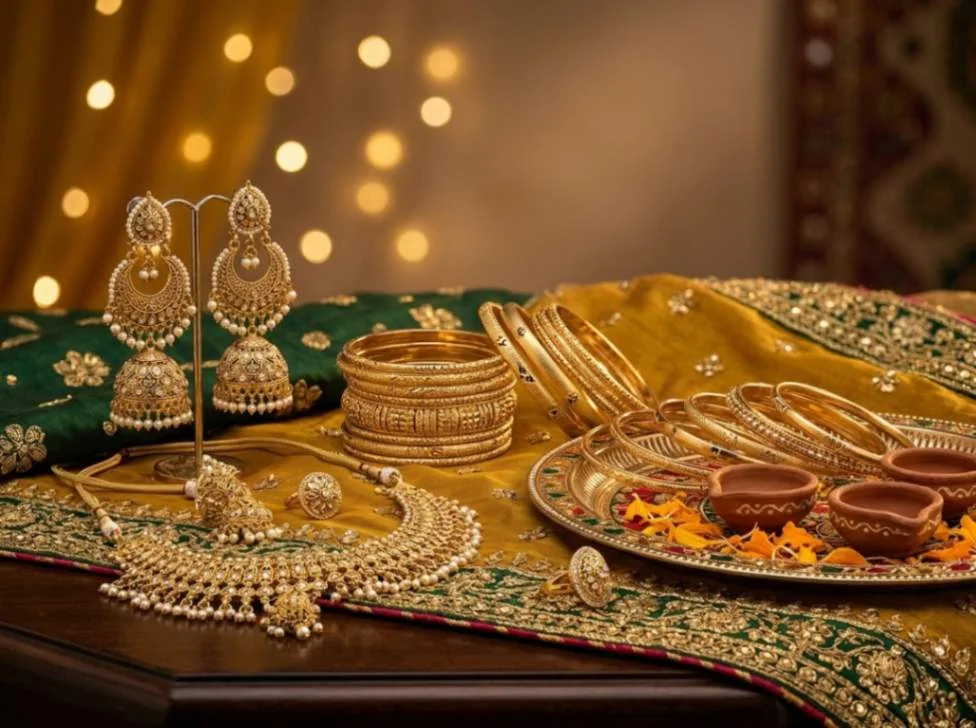
Gold jewellery for Mehndi night requires a lighter, more colorful, and more event-specific approach than the main bridal set worn on Baraat day. This guide covers the 5 most important jewellery decisions for Mehndi night earrings, bangles, necklace, budget allocation, and real gold versus artificial, and gives Pakistani brides the practical, fact-based guidance needed to choose correctly without overspending. Once your Mehndi set is sorted, the next decision is just as important.
Why Mehndi Night Deserves Its Own Jewellery?
Mehndi night is a separate occasion with its own dress code, physical demands, and visual requirements, and it requires a jewellery strategy entirely different from the main bridal set.
Why Mehndi Is a Separate Occasion With Its Own Dress Code and Mood
Mehndi night is defined by 3 characteristics that directly determine jewellery requirements: it is a high-movement event, it is color-dominant, and it lasts between 4 and 6 hours of continuous activity. Brides sit for extended henna sessions, dance, embrace family members, and remain physically active throughout. According to the Competition Commission of Pakistan (CCP), weddings and festivals account for approximately 70% of Pakistan’s annual gold demand, estimated at 60 to 90 tonnes per year. Within that demand, Mehndi night represents a distinct purchase category that is frequently mismanaged by buyers who apply Baraat-day thinking to a fundamentally different occasion.
Why Heavy Bridal Gold Is Often Too Much for This Event?
Heavy bridal gold full 22K Madrasi sets, dense multi-layered chokers, and solid haar necklaces are structurally unsuitable for Mehndi night for 2 practical reasons. First, these sets are designed for a stationary, regal presence on Baraat day, where the bride sits for extended photography sessions in controlled lighting. Second, the physical weight of a full bridal set, typically between 10 and 20 tolas, creates measurable discomfort within 2 hours of continuous wear during the dancing and movement of a Mehndi event.
How the Right Jewellery Adds to the Celebration Without Draining the Budget?
The correct Mehndi jewellery strategy prioritizes 3 qualities: lightweight construction, color coordination with the outfit, and post-wedding versatility. Pieces that satisfy all 3 qualities deliver full event utility without functioning as single-use purchases. The All-Pakistan Gems and Jewellers Sarafa Association (APGJSA) announces 22K gold rates daily as of May 2026, reaching approximately 426,705 PKR per tola, making every gram of gold purchased for Mehndi night a financial decision that deserves the same scrutiny as any other gold purchase.
Why So Many Brides Overspend on Mehndi Jewellery and How to Avoid It?
Pakistani brides overspend on Mehndi jewellery for 2 specific and preventable reasons. The first is sequential budget allocation, purchasing Mehndi jewellery first because the event comes first on the wedding calendar, leaving insufficient funds for the main bridal set. The second is that late-purchasing brides who begin shopping within 2 weeks of the event make rushed decisions under selection pressure and time constraints. Establishing the total wedding jewellery budget first and allocating the Mehndi portion last prevents both errors.
What Style of Gold Jewellery Works Best for Mehndi?
The gold jewellery style that suits Mehndi night best is lightweight, stone-accented, and movement-friendly pieces that add festivity without restricting physical activity or competing visually with the henna design on the hands and arms.
The Traditional Look vs the Modern Approach: What Pakistani Brides Choose Today?
Pakistani brides in 2025 and 2026 are making 3 distinct style choices for Mehndi night. The first is stone-accented yellow gold pieces featuring emeralds, rubies, pearls, or colored zircons set in 21K or 22K gold, which introduce color contrast against the Mehndi outfit without adding significant weight. The second is the layered lightweight look, a thin choker paired with a longer pendant chain, creating visual dimension without the physical load of a solid necklace. The third is the jhumki-dominant approach large colorful dangling earrings with minimal or no necklace, keeping the henna-covered hands and face as the visual center of the event.
Why Yellow Gold Dominates Mehndi Night Over White Gold or Diamonds?
Yellow gold dominates Mehndi night for a technical photographic reason: it delivers warm, defined tones under the mixed indoor and outdoor lighting typical of Pakistani Mehndi venues. White gold and diamonds, which perform well under the controlled studio lighting of Baraat photography, lose contrast and definition under the softer, warmer ambient light of Mehndi events. The deep yellow of 22K gold produced by its 91.67% purity and copper-dominant alloy photographs with consistent warmth across all Mehndi lighting conditions.
How to Match Jewellery Style to Your Mehndi Outfit Color
Matching jewellery to Mehndi outfit color follows 4 specific rules based on contrast rather than matching. Yellow and lime outfits suit gold with ruby or coral-toned stones. Pink and peach outfits suit gold with pearl or rose-toned accents. Green outfits suit gold with emerald stone settings. Orange and mustard outfits suit plain yellow gold or gold with amber-toned stones. The principle across all 4 pairings is visual contrast: jewellery color must differ from the dominant outfit color to create definition rather than visual saturation.
Earrings for Mehndi Night: What to Look For?
Earrings are the single most important jewellery piece on Mehndi night because they frame the face, appear in every close-range photograph, and remain fully visible throughout the henna session when the hands and wrists are occupied and adorned.
The Most Popular Earring Styles Worn at Pakistani Mehndi Events
Pakistani Mehndi events feature 5 dominant earring styles: jhumki earrings, chandelier drops, stone-accented hoops, pearl drops, and Kundan stud clusters. Of these 5, jhumki earrings remain the top choice across age groups and budget ranges. The jhumki’s bell-shaped body and hanging drop create continuous movement with every turn of the head a visual quality that suits the celebratory, kinetic atmosphere of Mehndi night. Meenakari jhumkis featuring colorful enamel work in reds, greens, and blues are particularly suited to Mehndi night because their color vocabulary directly mirrors the festive palette of Pakistani Mehndi outfits.
How to Choose the Right Size: Not Too Heavy, Not Too Plain?
Choosing jhumki size requires balancing 3 factors: face shape, outfit neckline, and wearing duration. A large dangling jhumki reaching the shoulder creates a strong visual impact but adds noticeable weight across a 4 to 6-hour event. A medium jhumki approximately 4 to 6 centimeters in drop length delivers the same visual character at half the physical load. For round or wide face shapes, longer drops with a narrow profile create elongation. For oval or narrow face shapes, wider chandelier drops add horizontal proportion.
Why Jhumki-Style Earrings Remain the Top Choice for This Occasion
Jhumki earrings remain the dominant Mehndi night choice for 2 structural reasons. First, their movement creates a continuous visual signal at close and medium range; they are active jewellery, not static. Second, jhumkis in colored stone settings, emerald, ruby, or pearl, introduce color definition against skin tone and outfit simultaneously, a dual function that no other earring style replicates with equal efficiency. Shop our collection of gold jhumki earrings, popular for Mehndi and festive occasions.
Bangles for Mehndi Night: How Many and What Style?
Bangles are a cultural and visual essential on Mehndi night. The sound of stacked bangles is synonymous with celebration in Pakistani wedding culture, and covered wrists complement the henna-covered hands that are the event’s focal point.
Why Bangles Are a Mehndi Night Essential in Pakistani Culture?
In Pakistani wedding tradition, bare wrists on Mehndi night carry cultural significance; they signal incomplete preparation. A full bangle stack on at least one arm is the minimum cultural expectation at formal Pakistani Mehndi events across Karachi, Lahore, and Hyderabad. The visual requirement is a continuous band of gold or color from wrist to mid-forearm, creating the framed context within which the henna design is displayed and photographed.
How Many Bangles to Wear and How to Stack Them Without Overdoing It?
The practical answer for bangle quantity on Mehndi night is 8 to 16 bangles on the arm, not being hennaed first, transitioning the stack after the henna sets. A full stack of 20 or more bangles on both arms simultaneously creates visual excess and physical discomfort during a 4 to 6-hour event that requires continuous arm movement. The most visually effective stacking approach alternates 3 bangle types: 2 plain gold bands, 1 twisted or patterned band, repeated across the full stack. This alternation creates visual rhythm without requiring every bangle to carry complex design work.
Which Bangle Styles Suit Mehndi Best?
The 3 bangle styles that suit Mehndi night most effectively are twisted gold bangles, stone-set colored bangles, and choorian-style stacks in mixed festive colors. Plain pipe bangles, smooth, undecorated circular bands, are visually insufficient for Mehndi night as a standalone choice. Twisted bangles add surface texture and catch light with movement. Stone-set bangles in emerald, ruby, or multicolor combinations echo the color palette of the Mehndi outfit. Choorian stacks in yellow, green, orange, and pink represent the most traditional and most photographed bangle choice at Pakistani Mehndi events. Browse our range of gold bangles for Mehndi in styles that suit every budget and outfit.
How to Match Bangle Weight and Finish to the Rest of Your Set?
Matching bangle finish to the broader jewellery set follows 1 rule: the surface quality of the bangles must match the surface quality of the earrings. Matte antique gold bangles pair with matte antique gold jhumkis. Bright polished bangles with stone settings pair with bright polished stone-set earrings. Mixing matte and high-gloss finishes within the same set creates visual inconsistency that reduces overall impact in both live appearance and photography.
Should You Wear a Necklace on Mehndi Night?
A necklace on Mehndi night adds value when the outfit neckline is plain and reduces the overall look when the neckline carries heavy embroidery or a high collar.
When a Necklace Adds to the Look and When It Competes With the Outfit?
Pakistani Mehndi outfits fall into 2 neckline categories that determine necklace suitability. The first is an open or low neckline, a simple round, V-shape, or boat neck with minimal embroidery at the collar. This neckline benefits from a necklace because the bare neck creates visual space that jewellery fills with purpose. The second is a high or heavily embroidered neckline, a standing collar, a gota-bordered high neck, or dense stonework at the collar line. Adding a necklace over this neckline creates visual congestion that diminishes both the outfit and the jewellery simultaneously.
Lightweight Choker vs Layered Necklace: Which Works Better?
A lightweight choker, a thin band sitting at the base of the throat, outperforms a layered necklace for Mehndi night across 3 criteria. It adds neck definition without bulk, remains comfortable during 4 to 6 hours of sitting and movement, and does not compete with heavily embroidered upper-body detailing. A layered necklace, 2 or more chains of varying lengths worn simultaneously, suits Mehndi night only when the outfit neckline is completely plain and the earrings are minimal in size.
Why Many Pakistani Brides Skip Heavy Necklaces on Mehndi Night Entirely?
Many Pakistani brides skip the necklace entirely on Mehndi night and invest fully in statement earrings and a strong bangle stack instead. This 2-piece approach to jhumkis and bangles delivers the complete visual requirement of a Mehndi look without the physical discomfort or visual congestion of a third heavy piece. For brides wearing heavily embroidered Mehndi outfits where the collar and shoulder area carry rich surface detail, this approach produces a stronger overall result than a 3-piece set of lower individual quality.
Gold Tops and Lightweight Earring Options for a Simpler Look
Gold tops are small, dome-shaped or flat-surfaced gold earrings that sit directly on the earlobe without any drop or pendant, a minimal alternative to jhumkis suited to Mehndi daytime events and brides who prefer understated elegance.
Why Some Brides Prefer Minimal Earrings Over Statement Jhumkis?
3 bride profiles choose gold tops over jhumkis for Mehndi night. First, brides attending daytime Mehndi events held in the late morning or early afternoon, where the intimate, casual atmosphere makes large statement jhumkis visually excessive. Second, brides with sensitive ear piercings that cannot support extended hanging weight for 4 to 6 hours. Third, brides combining real gold earrings with a heavily accessorized look, full bangle stack, maang tikka, nath, where keeping earring size minimal prevents visual overload.
What Gold Tops Are and Why They Work Well for Mehndi Daytime Events?
Gold tops in 21K or 22K with a single center stone, a small ruby, emerald, or pearl delivers event-appropriate elegance without physical weight. They photograph cleanly at close range, do not compete with the henna design or facial features, and transition directly from the Mehndi event to casual daily wear after the wedding, satisfying the post-wedding versatility requirement that statement jhumkis frequently fail to meet. See our range of gold tops for a clean and elegant Mehndi look.
How to Build a Complete Mehndi Jewellery Set on a Budget?
A complete Mehndi jewellery set is built by prioritizing 2 pieces first, earrings and bangles, and adding necklace and maang tikka only when the budget allows, without compromising the main bridal set allocation.
What to Prioritise When Money Is Limited?
Earrings and bangles are the 2 foundational pieces of a Mehndi jewellery look. Earrings frame the face in every close-range photograph. Bangles cover the wrists that are the event’s visual focal point. A bride who allocates her full Mehndi budget to 2 excellent-quality pieces produces a stronger result than a bride who distributes the same budget across 5 mediocre pieces. Depth of quality in fewer pieces consistently outperforms breadth of quantity at Mehndi events, where photography captures face and wrist detail at close range throughout the night.
Where Making Charges Eat Into Your Budget?
Making charges on Mehndi jewellery frequently consume a disproportionate share of the total cost. According to market data compiled from Pakistani Sarafa markets, ujrat on hand-crafted gold jewellery in Pakistan ranges from 1,000 PKR to 5,000 PKR per tola for standard designs, rising to 3,000 PKR to 7,000 PKR per gram for intricate stone-set or Meenakari pieces. A Mehndi jhumki set that appears moderately priced because it is lightweight in gold content can carry 30% to 40% of its total cost in making charges, money that is unrecoverable at resale. Comparing making charges across 3 jewellers before purchasing is the single most effective cost-reduction step available to Pakistani gold buyers.
When to Buy Real Gold and When Artificial Works Fine?
Real gold makes financial sense for Mehndi jewellery under 2 specific conditions: when the pieces are versatile enough for multiple post-wedding occasions such as Eid, formal events, and family gatherings, and when they are heavy enough in gold content to function as a stored-value asset. A 22K jhumki pair weighing 2 to 3 tolas satisfies both conditions: its metal value appreciates with the gold rate over time, and it is wearable across multiple annual occasions.
High-quality artificial jewellery is the more practical choice for Mehndi pieces that are highly occasion-specific, colored stone bangles in orange and green coordinated to a specific outfit, floral-motif sets suited only to the Mehndi aesthetic, or trend-driven designs with a useful life of 3 to 5 years before they appear dated. The CCP’s 2025 Competition Assessment Study of Pakistan’s Gold Market notes that informal gold trading dominates over 90% of the market, a structural reality that makes artificial jewellery a lower-risk choice for event-specific Mehndi pieces where purity verification is difficult and resale value is not a purchase objective.
Common Mistakes Pakistani Brides Make When Buying Mehndi Jewellery?
Pakistani brides make 4 recurring and preventable mistakes when purchasing Mehndi jewellery.
Buying pieces that clash with the Mehndi outfit color is the most photographically damaging error. Purchasing jewellery before the outfit is finalized, or selecting pieces without comparing them directly against the outfit fabric in natural light, produces color conflicts that reduce the visual impact of both the outfit and the jewellery. Bring the outfit fabric or a clear photograph to every jewellery shop visit.
Choosing a set that is too heavy for the event’s physical demands causes discomfort within the first 2 hours of a 4 to 6-hour event. Heavy necklaces pressed against the collarbone during prolonged sitting, bangles that shift during henna application, and large earrings that strain the earlobes during dancing reduce the bride’s comfort and visible enjoyment of the event. Wearing every piece for a minimum of 10 minutes in the shop before purchasing identifies weight issues before they become event-day problems.
Overspending on Mehndi gold and running short on the main bridal set is the most financially consequential error. Pakistani families frequently allocate gold budgets, sequentially purchasing Mehndi jewellery first because the event appears first on the wedding calendar. This approach consistently leaves insufficient funds for the 22K bridal set required for Baraat day. Establish the total wedding jewellery budget first. Allocate the main bridal set requirement second. Assign the Mehndi jewellery budget from the remaining funds.
Leaving the purchase too late and settling for poor quality affects both selection quality and purity verification. Brides shopping within 2 weeks of the Mehndi date find limited selection, no time for custom orders, and insufficient time to take pieces to an independent assaying center for purity verification. Begin Mehndi jewellery shopping a minimum of 6 weeks before the event date.
A Simple Checklist Before You Buy Your Mehndi Set
Before finalizing any Mehndi jewellery purchase, confirm 4 criteria:
Does it match your outfit color and style?
Compare the jewellery against the outfit fabric in natural light, not under the jewellery shop’s display lighting, which is designed to make all gold appear at its best regardless of compatibility.
Is the weight comfortable enough to wear for several hours?
Wear the complete set in the shop for a minimum of 10 minutes. Stand, sit, and move your arms fully. Any piece that feels restrictive or heavy at 10 minutes produces significant discomfort at 4 hours of continuous wear.
Have you confirmed the making charges separately from the gold rate?
Request a written breakdown of the gold metal value versus the ujrat before agreeing to any price. For Mehndi pieces worn once or twice, making charges exceeding 20% of the total purchase price require specific justification from the jeweller.
Is the set versatile enough to wear again after the wedding?
Mehndi jewellery in classic yellow gold with neutral or muted stone setting, pearl, champagne zircon, or light emerald transitions to Eid, formal events, and family occasions far more effectively than highly occasion-specific colored sets purchased to match a single outfit.
Mehndi night jewellery establishes the first visual chapter of the full wedding jewellery journey. A bride who approaches Mehndi jewellery with a clear budget boundary, an outfit-first selection process, and a practical understanding of making charges enters the main bridal jewellery shopping process with her financial resources intact and her priorities in order.
Getting Mehndi night right in terms of weight, color, and budget sets the tone for every jewellery decision across Baraat and Walima. Once your Mehndi set is sorted, the next decision is just as important. Read the complete guide on matching gold to your bridal dress for a full colour-by-colour breakdown.

